Showing posts with label Literature. Show all posts

Friday, December 21, 2012

Transcendentalism

            Transcendentalism is one of the most influential American intellectual movements. It is a set of ideas that no American author from the nineteenth century could escape from, either to criticise it or to accept it.
People from around the world started talking about it. Americans were proud about that fact. It is an obscure movement, mixing literature, religion and philosophy. Especially interesting is their view of God. They redefined their idea of Him, of man and of the relationship between the two.
The Transcendentalists had the concept of the oversoul (“what there is”). The oversoul may be divided into two: man and nature. 
And the place God (the divinity; it did not necessarily refer to a human-like being) takes is everywhere, in man and in nature. They considered him far from being a figure removed from man. The divinity was not the most important thing, not more so than man or nature. There was no way to reach the divinity, but there are two things that may be done to understand it better: understand, explore oneself and nature.
Transcendentalism occurred when the main philosophical ideas were Pragmatism, Empiricism and Utilitarianism.
The name of this movement is very self-explanatory: it means to go beyond; beyond material reality, towards the truth. To go beyond material reality one has to either be a poet or use reason.
A poet is the one who has the ability to cross reality with a special insight, and who is able to communicate it to other people. The poet works with intuition.
Reason was used then to refer to what we now know as intuition (or what Emerson called understanding) or instinct.
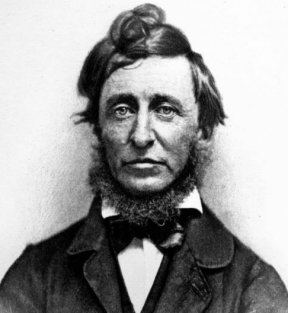
The most important transcendentalist poets were Ralph Waldo Emerson and Thoreau.


To know more about these poets, I give you some interesting webs, in which you can see texts (how they used languange) , their biographies and more.
http://www.emersoncentral.com/
http://www.thoreausociety.org/

Source: 
http://www.alcoberro.info/imatges/thoreau.jpg
https://blogger.googleusercontent.com/img/b/R29vZ2xl/AVvXsEjglskLt9YCE8bHoAxs5RWXlFhYCpw2KexgHF37-h4ifw1ae-TUPsFnrDBHUkdK8K0f_ZrOO4sdZOZeTWIAa-7iqZMbHcSB8CiVWl-APCc6f_XIT84MwH3FkPBbi5dCEqbibr0SY6pfpYI/s320/Ralph+Waldo+Emerson.jpg


Wednesday, November 14, 2012

Literature, a way of undestanding USA

          Along the history of the United States, literature has marked an important role in the way in which Americans could feel understood at the view of the other side of world.

         Essays, poems, letters, speeches or songs form part of the American culture. Different points of view of the same topic in the same time or at a different one can make us see how the past times were, how people felt in each crisis, war, revolution o peaceful period.

         The literary language has been and still is a useful tool that has helped to specialists in history to develop important progressions in their theories and to prove and make an idea of how past times were. Literature  in the United States has contribuited and have played an important role in creating the nation's character, bearing in mind the several compositions from  different people: negros, women, writers, presidents, working-classes, native-borns, immigrants... Some of these texts are not considered as literary ones, and perhaps they will never be, but they are a very fiable source of understanding people and knowing different forms of knowledge, apart from these ones which have been and are great masterpieces of History.
          
         Important texts for and from the Americans and that are very useful in knowing the history of the United States could be the following ones:

  -FROM THE REVOLUTION: Declaration of Independence (Thomas Jefferson)
  -REFORM AND EXPANSION: Civil Disobedience (Henry David Thoreau)
  -CIVIL WAR: The Gettysburg Address (Abraham Lincoln)
  -POST CIVIL WAR: Speech at the National Convention of Colored Men (Frederick Douglas)
  -THE PROGRESSIVE AGE: The Solitude of Self (elizabeth Cady Stanton)
  -WORLD WAR I: War Message to Congress (Woodrow Wilson)
  -DEPRESSION AND WORLD WAR II: Happy Days are Here Again (Milton Ager and Jack Yellen)
  -AFTER WORLD WAR II: The Silent Generation (Louis Simpson)
  -TROUBLE TIMES/ CONTEMPORARY TIMES: I have a dream (Martin Luther King Jr.)


Source: "The American Reader, Words that moved a Nation", by Diane Ravitch.

By Estefanía Benítez Sánchez